
I spent a good two days going through the documents in this folder. More than once, tears welled up in my eyes.
Because these documents are a vivid picture of World War II in the Biłgoraj county. Stories partly familiar to me, but also entirely new facts – written down in the heat of the moment, right after the end of hostilities. And that is precisely why they carry such power and authenticity that cannot be recreated years later.
If you are interested in genealogy or simply curious about the history of your own town – look for such documents, for example online on the Szukaj w Archiwach (Search in Archives) portal. They can tell an incredible amount about what our ancestors had to face during those difficult times.
The post-war years were incredibly hard. People returned to their homes from various deportations, camps, and wanderings, often to find nothing but ruins. Frequently there was no house left, and if it survived – it had been completely stripped bare. Yet somehow, life had to begin anew.
The state offered relief payments to people affected by the war, and many took advantage of this opportunity. In the justifications of their applications, they described their current situations and wartime fates. This is precisely why these documents are so invaluable to family history researchers today – they contain stories of people that might otherwise have been lost forever.
Below you will see several such documents from the Biłgoraj county in the Lublin voivodeship. They concern residents of places such as: Józefów, Zamch, Księżpol, Wola Obszańska, Biłgoraj, Goraj, Frampol, and Łukowa.
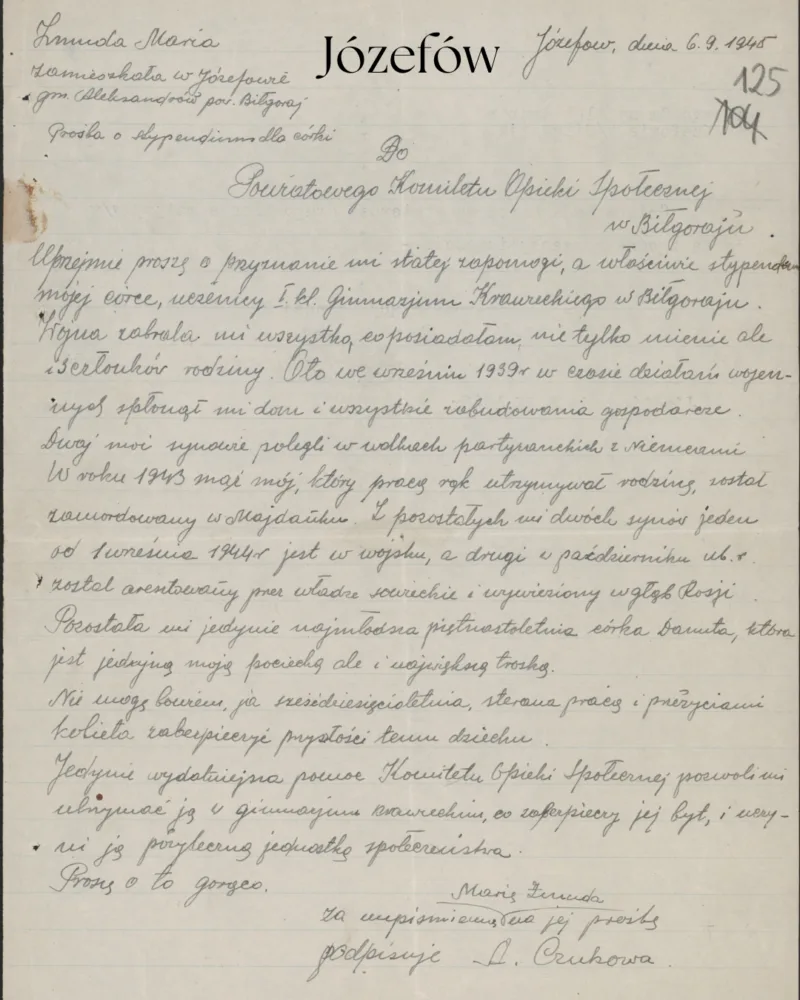
On September 6, 1945, Maria Żmuda from Józefów submitted a request for a scholarship for her daughter, a first-year student at the Tailoring Secondary School in Biłgoraj. In her justification, she describes the dramatic situation of her family. The war took her loved ones, her home, and farm buildings. Two sons died in partisan battles, and her husband was murdered at Majdanek. One of her surviving sons was serving in the military, while another had been arrested and deported deep into Russia.
“All I have left is my youngest fifteen-year-old daughter Danuta, who is my only consolation but also my greatest concern. For I, a sixty-year-old woman, worn out by work and hardship, cannot secure a future for this child.“
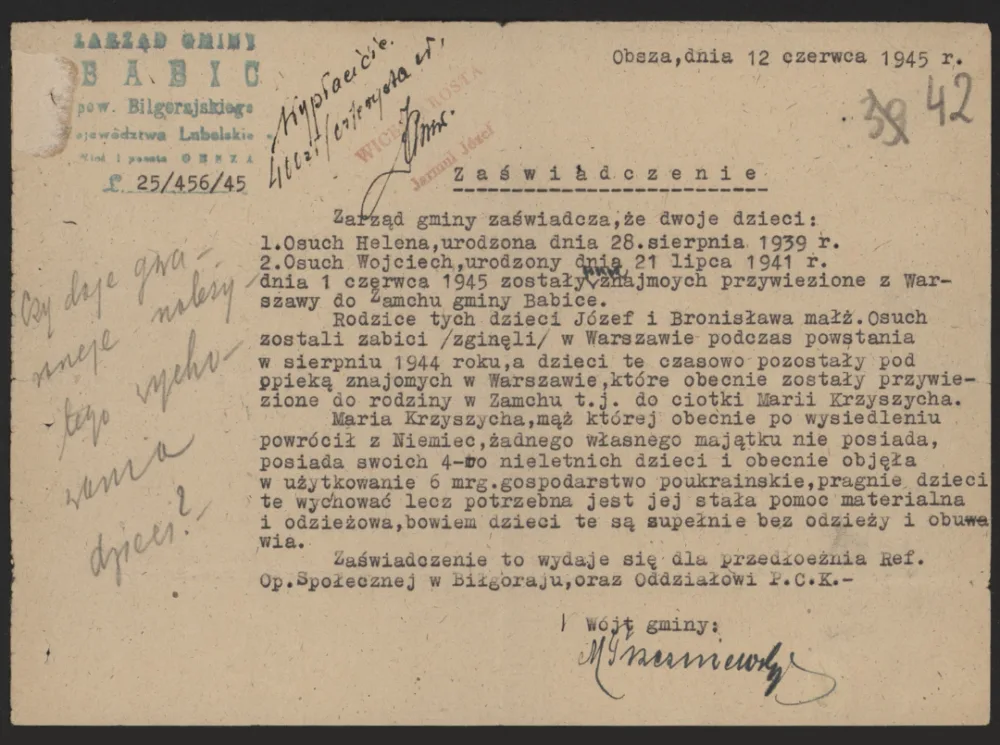
Maria Krzyszycha, a resident of Zamch, appealed for permanent material and clothing assistance to support the children of her sister Józefa. Józefa and her husband, Bronisław Osuch, perished during the Warsaw Uprising. The orphaned children – Helena, born in 1939, and Wojciech, born in 1941 – were brought from Warsaw to Zamch after the war and placed in the care of their aunt Maria.
However, the woman’s situation was very difficult. She had no property of her own, and she already had four children to support. She had only recently taken over a small, six-morgen post-Ukrainian farm. Despite this, she declared her willingness to raise her sister’s children, though she admitted it might prove impossible without outside help.
Today I know the rest of this story – thanks to the descendants of Helena and Wojciech. Fate took a different course than their aunt had planned. The children were ultimately adopted by two different families who raised them.
It is hard to say today why this happened. Perhaps Maria Krzyszycha did not receive the help she needed, or perhaps it was decided that the children would find it easier to start a new life elsewhere. Yet the document remains a testimony of that moment – when a woman tried to save her deceased sister’s family.
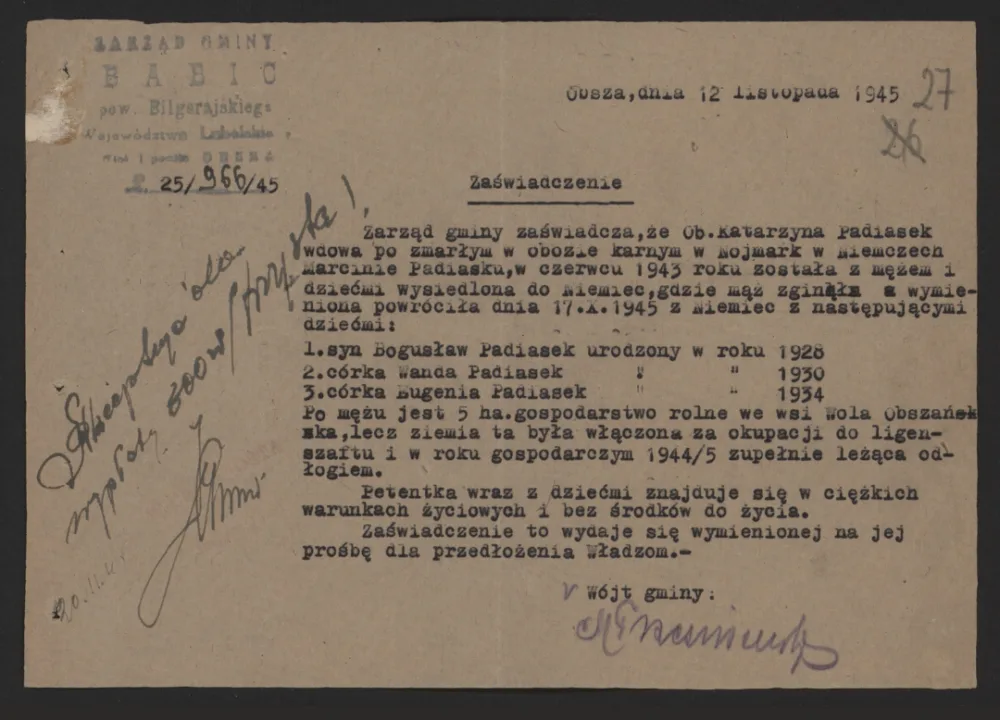
After years of forced labor and wandering, Katarzyna Padiasek returned to her native village of Wola Obszańska with three children: Bogusław, Wanda, and Eugenia. Her husband, Marcin Padiasek, was no longer with her – he had perished in the German penal camp at Neumark. The farm that once belonged to the family had been seized by the Germans during the occupation and now lay fallow. The woman was left alone with her children and no means of survival.
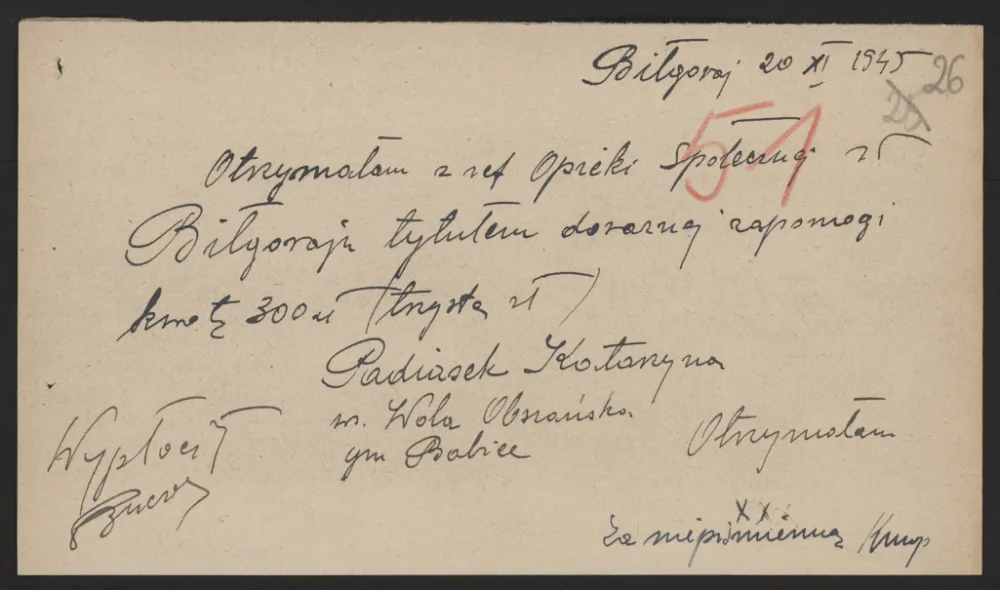
On November 20, 1945, Katarzyna received a sum of 300 PLN as emergency relief.
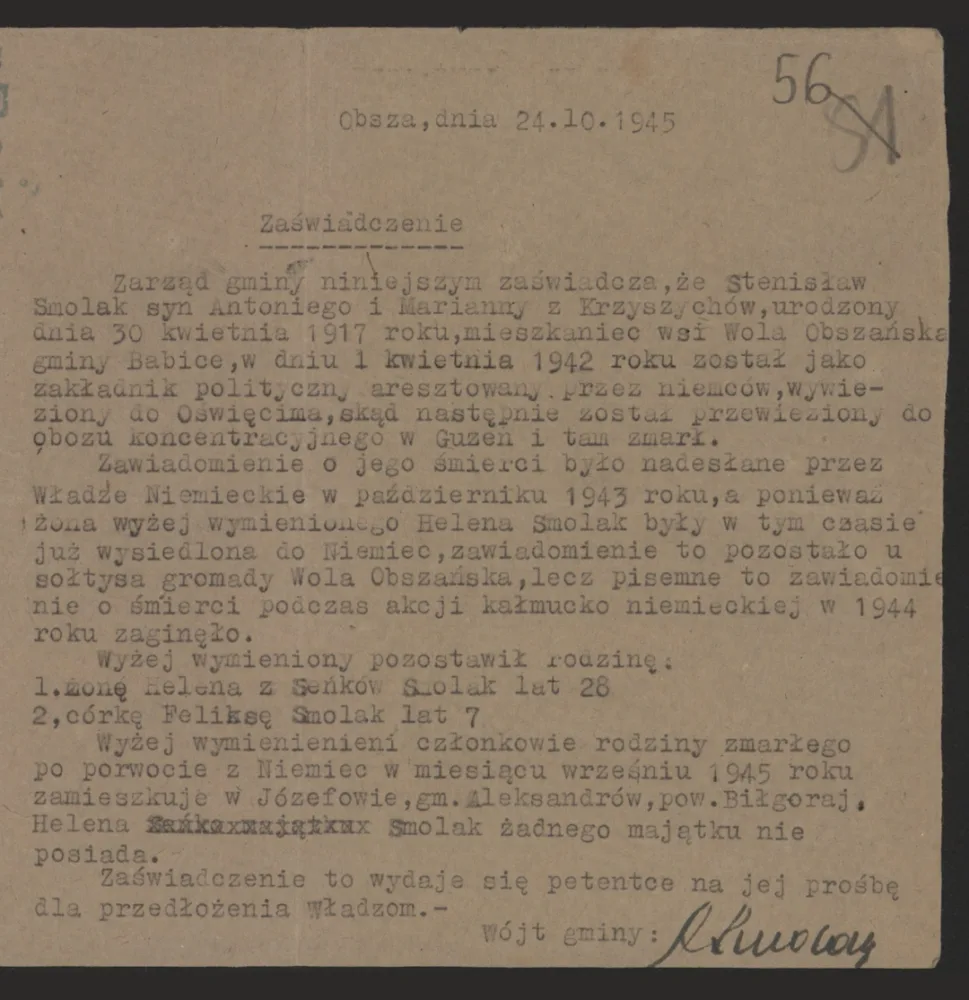
In the autumn of 1945, Helena Smolak returned from deportation in Germany. She came back alone with her small daughter. She settled in Józefów in the Aleksandrów commune, Biłgoraj county. She had no property or means of survival.
One of the documents in the post-war file is a certificate issued at her request by the Babice Commune Administration. The official record confirms the tragic fate of her husband.
Stanisław Smolak, son of Antoni and Marianna née Krzyszycha, a resident of Wola Obszańska, was arrested by the Germans on April 1, 1942, as a political hostage. He was first sent to prison in Auschwitz, then transferred to the Gusen concentration camp, where he died.
The German authorities sent notification of his death in October 1943. However, by that time Helena herself had already been deported to Germany, and the news remained with the village head of Wola Obszańska. The actual death certificate was lost during the Kalmyk raid in 1944.
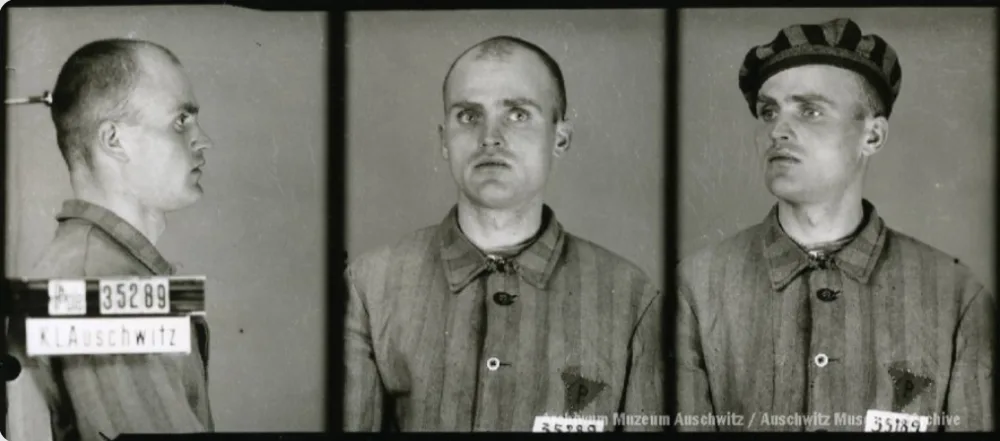
I also found information about Stanisław Smolak in the Auschwitz-Birkenau prisoner search engine. It shows that he arrived at the camp on May 13, 1942, and was assigned prisoner number 35289. He died a few months later, on September 22, 1942, at KL Mauthausen, of which Gusen was one of the sub-camps.
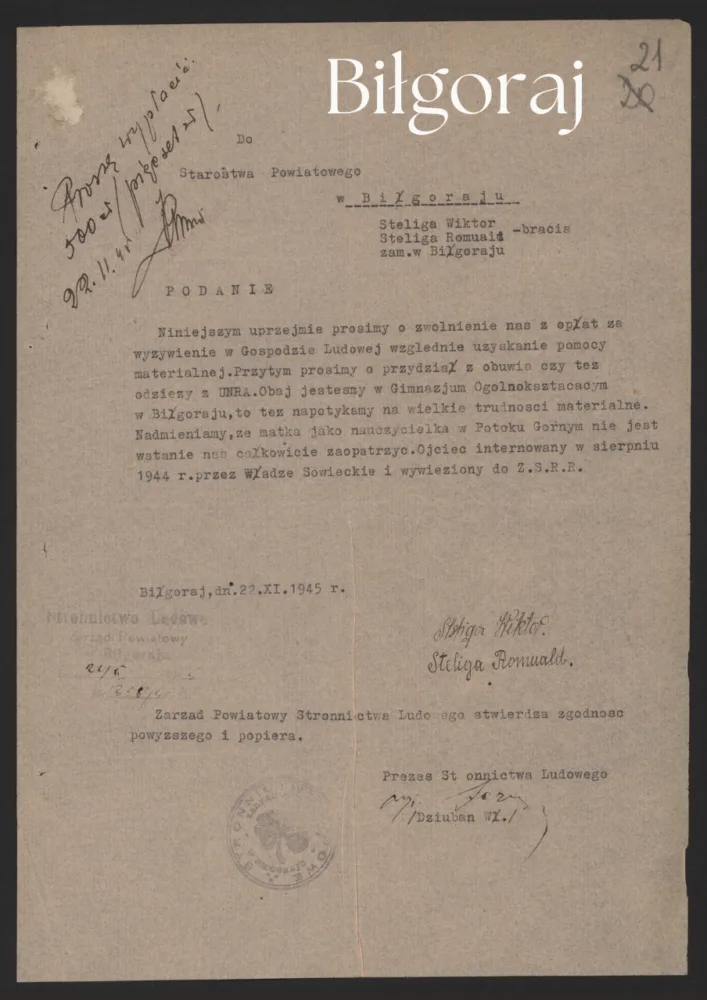
In November 1945, a petition reached the County Office in Biłgoraj, written by two students of the local secondary school – Wiktor and Romuald Stelig. The brothers asked for material assistance that would allow them to continue their education in the difficult post-war conditions.
In their petition, they primarily requested exemption from meal fees at the People’s Inn, as well as an allocation of footwear or clothing from UNRRA aid.
They also wrote about their family situation. Their mother worked as a teacher in Potok Górny, but her earnings were insufficient to fully support her sons. The greatest blow to the family was the arrest of their father. In August 1944, he was interned by Soviet authorities and deported deep into the Soviet Union.
In the margin of the document, there is a handwritten official note showing that the request was approved – the brothers were granted 500 PLN in assistance.
This short document shows the problems post-war youth faced. Many students tried to continue their education despite a lack of money, absent fathers, and difficult family situations. In such cases, even modest help could determine whether a young person would be able to keep studying.
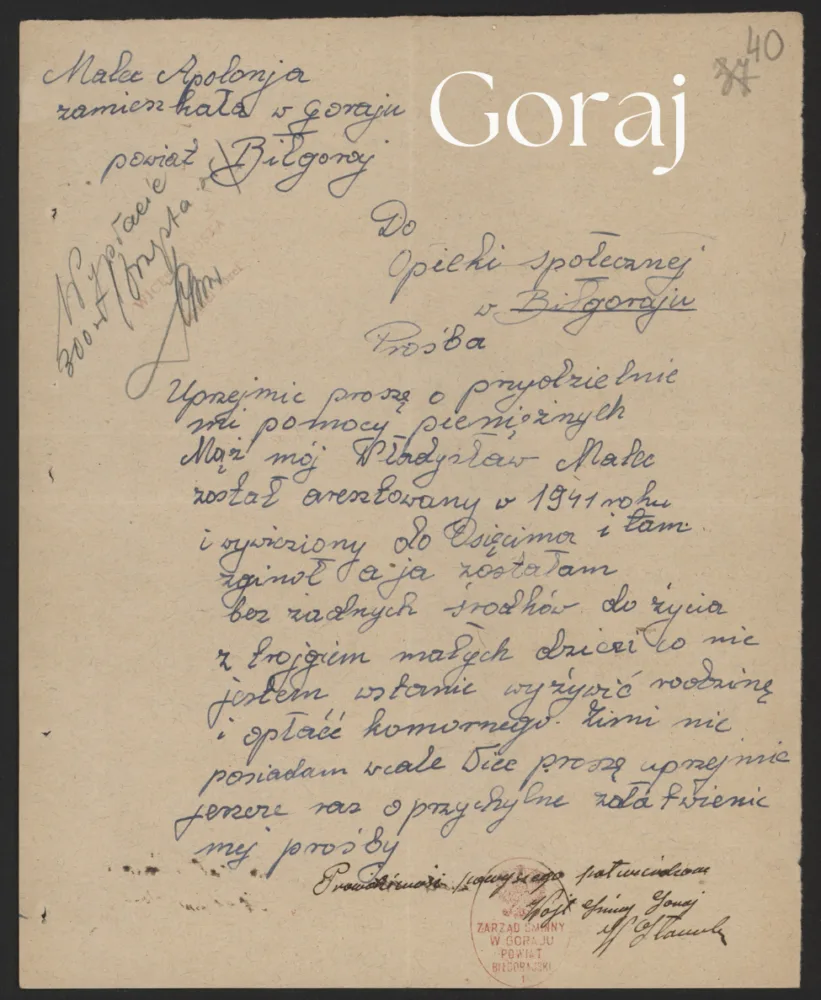
Apolonia Malec from Goraj, in a handwritten letter, turned to Social Services in Biłgoraj with a polite request for financial assistance. She described her situation very simply, without unnecessary words.
Her husband, Władysław Malec, was arrested in 1941 and deported to the camp at Auschwitz, where he perished. From that moment on, Apolonia was left alone with three small children.
In her petition, she writes plainly that she has no means of survival. She is unable to support her family or pay the rent. She also emphasizes that she owns no property whatsoever.
After reviewing her request, Social Services granted Apolonia a relief payment of 300 PLN.
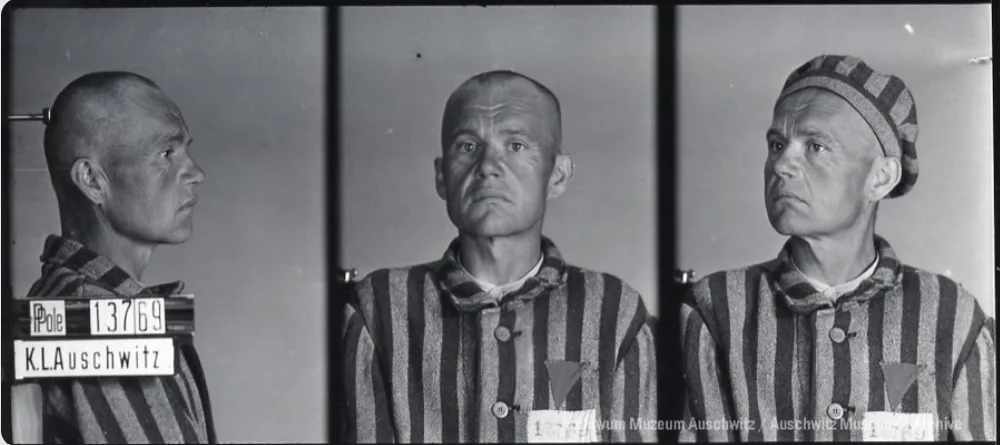
I also found Apolonia’s husband – Władysław Malec – in the Auschwitz-Birkenau prisoner database. The brief record shows that he was born on September 22, 1901, in Goraj and was a shoemaker by trade. He arrived at the camp on April 6, 1941, where he was assigned prisoner number 13769. He died a few months later – on August 14, 1941.
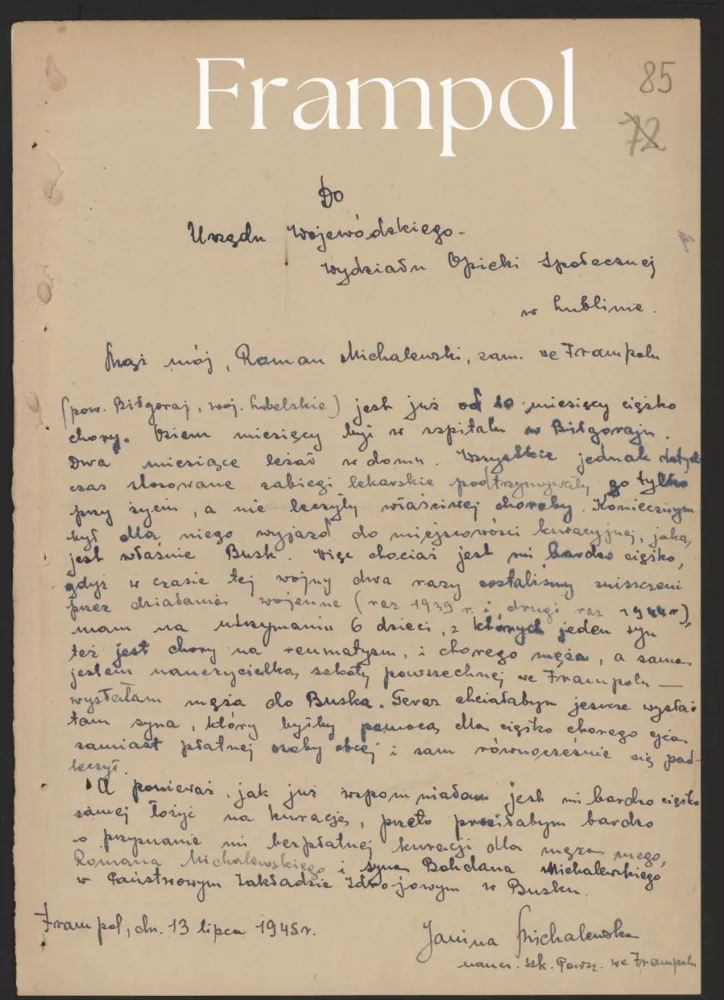
In July 1945, Janina Michalewska from Frampol turned to the Voivodeship Office – Department of Social Welfare in Lublin, requesting help for her family. In her petition, she describes the dramatic health situation of her husband, Roman Michalewski, who had been seriously ill for many months. He had spent half a year in the hospital in Biłgoraj, and after returning home he required further treatment. Doctors recommended a treatment stay in Busko.
Janina emphasized that during the war, the family had twice lost all their possessions. She was supporting six children, and one of her sons was also ill. She worked as a teacher at the primary school in Frampol, but her earnings were not enough to cover the cost of treating two people.
Therefore, she requested that her son Bohdan be allowed free treatment at the State Spa in Busko, where he could also support his father who was already there. This document is yet another testimony of post-war reality, in which many families struggled simultaneously with illness, poverty, and the consequences of wartime destruction.
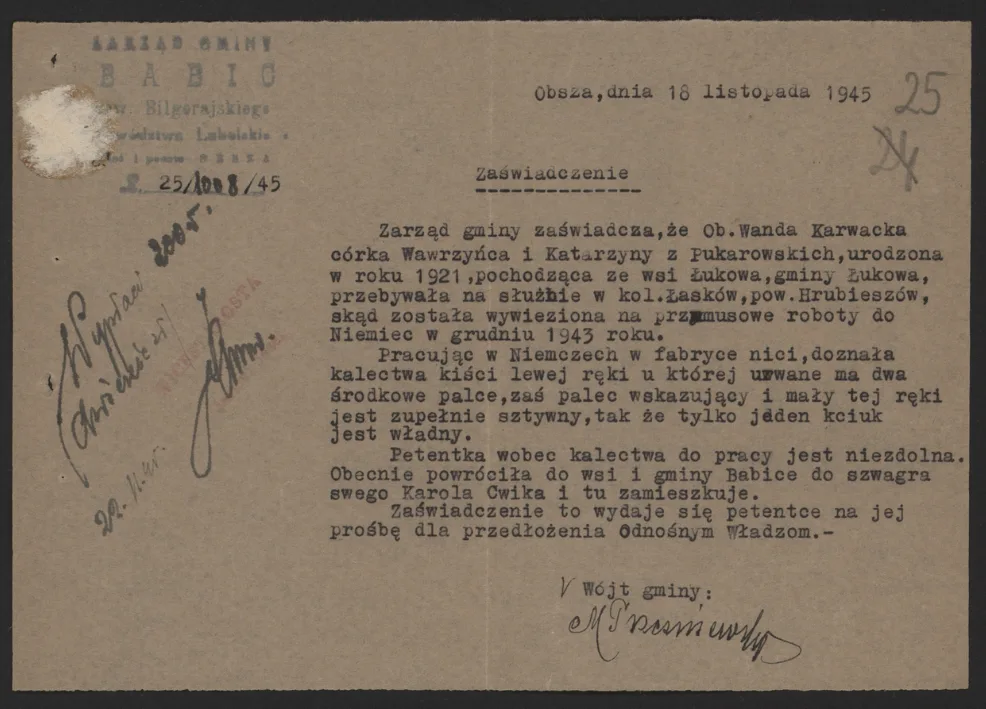
Wanda Karwacka, daughter of Wawrzyniec and Katarzyna née Pokarowska, born in 1921 in the village of Łukowa, worked as a servant in the Łasków colony in Hrubieszów county. From there, in December 1943, she was deported for forced labor in Germany.
While working in a German thread factory, a tragic accident occurred. Wanda suffered severe mutilation of her left hand – two middle fingers were torn off, and the index and little fingers became stiff. Only the thumb remained functional. As a result of this injury, she became unable to work.
After returning from Germany, she moved in with her brother-in-law Karol Ćwik in the Babice commune. Wanda was granted 200 PLN in relief.
The documents from this single folder show what daily life looked like for residents of Biłgoraj county just after the end of World War II. In brief petitions and official certificates, the dramas of ordinary people are recorded: widows, orphans, families deprived of homes and livelihoods.
Some lost loved ones in concentration camps, others returned from deportations and forced labor maimed or ill. Many were left alone with children, without property or means to support their families. That is why they turned to the authorities for relief payments, scholarships, material aid, or medical treatment.
Although these are merely individual stories from a few towns – Józefów, Zamch, Wola Obszańska, Goraj, Biłgoraj, and Frampol – together they paint a moving picture of post-war reality. They show that the end of the war did not mean the end of suffering. For many people, it was only the beginning of a difficult struggle to rebuild their lives from scratch.
Today, these documents are an invaluable testimony to the fates of our ancestors and a reminder of the enormous price paid by local communities for the years of war.
Source: Petitions and requests, as well as receipts for emergency relief payments for former concentration camp prisoners, war invalids, etc. for the year 1945. Held by the State Archives in Lublin, Kraśnik Branch, reference number 37/3/0/-/345